•
2 min read
Why manager-employee disagreement is the most valuable part of a skill evaluation

Judith
Product Manager
The moment of disagreement in a skill evaluation
Two people rate the same skill, for the same person, but the verdicts are different.
What happens in your company when the manager and employee disagree on a skill evaluation? Does the conversation get uncomfortable? Does the performance review turn into a negotiation instead of a constructive conversation?
Reframe the angle: disagreement is data, not friction
A gap between how a manager and an employee assess the same skill is a signal. Often the most useful signal in the entire evaluation.
Most evaluation processes treat disagreement as a problem to resolve. One score has to win. Someone has to back down. The result: a watered-down assessment that reflects negotiation and not capability.
That framing is the real problem.
What a "different assessment" actually surfaces
When a manager and employee score the same skill differently, four things are usually true:
The manager and employee are working from different evidence
The skill is being applied in contexts only one of them sees
Expectations were never made explicit in the first place
Growth has happened that hasn't been recognized yet
Each of these is more valuable than the score itself. The data point isn't about the scoring, it's about the delta.
A real example: Sarah's data analysis skills
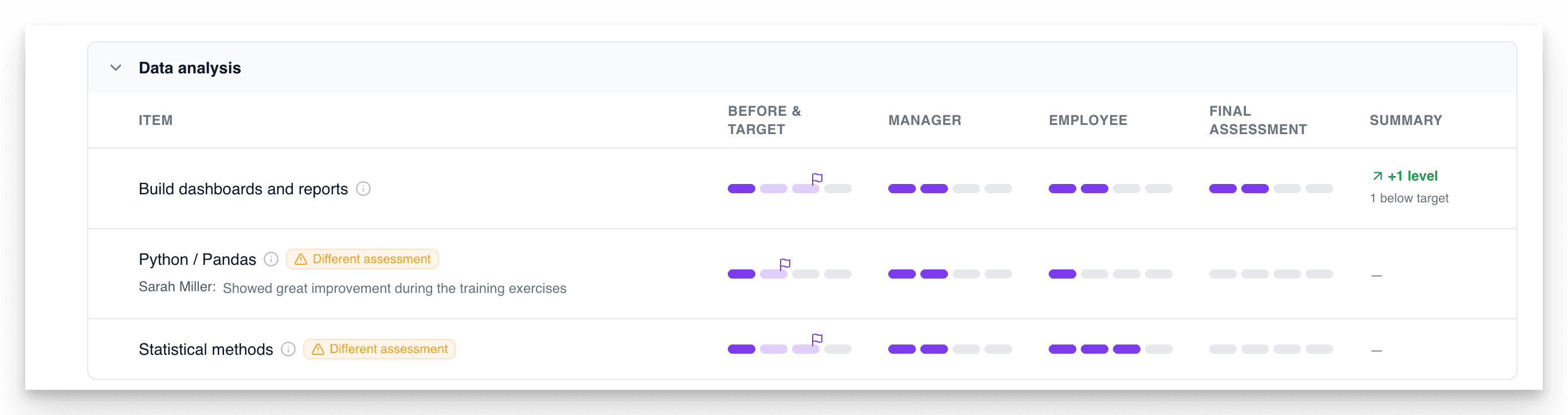
In the evaluation above, Sarah's manager and Sarah see her Python skills differently, and her statistical methods even more so.
That gap is the entire conversation worth having.
The main question is: what are we each looking at, and what does the work actually show?
That shift, from defending scores to comparing evidence, is where skill evaluations become incredibly powerful and beneficial.
How to turns evaluation disagreement into useful data
Three practices make the difference:
Surface the gap explicitly. Show both assessments side by side. Don't average them away.
Anchor the conversation in evidence. What did each person actually observe? Which projects, deliverables, or moments shaped their view?
Treat the delta as input, not error. A two-level gap signals something structural: misaligned expectations, hidden context, or unrecognized growth.
The takeaway
Skill evaluations get more valuable when disagreement becomes a conversation starter instead of a point of friction.
The manager isn't wrong. The employee isn't wrong. The gap between them is the most honest piece of data in the entire evaluation, if you choose to read it that way.
Start planning your workforce better
Free trial for up to 5 employees